

Catfish belong to the order Siluriformes, a diverse group that includes the Ictaluridae family of 51 North American catfish species. Beyond these, lesser-known families include the sea catfishes (Ariidae), labyrinth catfishes (Clariidae), and suckermouth armored catfishes (Loricariidae). While dozens of species swim in North American waters, a handful dominate the attention of anglers, biologists, and conservationists.
This guide covers the "Big Three" catfish species pursued by most anglers, along with lesser-known types you may encounter, and provides clear identification markers for each.
The Big Three of Catfish
Channel Catfish (Ictalurus punctatus) – The bread and butter of American restaurants serving fish, channel catfish are highly sought after by both anglers and the commercial market. They are among the cheapest fish to raise in hatcheries, making them ideal for stocking community ponds, lakes, and rivers. Channel catfish grow quickly and are found throughout most of North America due to widespread stocking programmes. They don't typically exceed 30 pounds but are generally more abundant than blue or flathead catfish. The all-tackle world record for channel catfish stands at 58 pounds, caught in 1964 in South Carolina's Santee-Cooper Reservoir. In 2025, Dylan Kampnich of New York established a new state record with a 37-pound, 9-ounce channel catfish caught in Lake Ontario's Black River Bay marsh.
Blue Catfish (Ictalurus furcatus) – Living in the memories and storybooks of North America, thanks to authors like Mark Twain, the blue catfish is the largest catfish species in North America. Its impressive size draws anglers to rivers in hopes of catching a giant. Blue catfish are predominantly found in rivers but also inhabit lakes. They can adapt to higher salinity levels and have caused significant ecological disruptions in areas like Maryland, where they were introduced to the Potomac River and Chesapeake Bay.
2025 Record Updates: In October 2025, George Thompson reeled in a 105-pound, 60-inch blue catfish from the Missouri River near Council Bluffs, Iowa – a 35‑minute battle that broke a 21‑year state record. Earlier that year, in January 2025, Pat Hutchinson set a new IGFA Women's 3‑kg (6 lb.) Line Class World Record with a 30‑pound blue catfish caught on the James River in Virginia. The current all‑tackle world record for blue catfish stands at 143 pounds.
Flathead Catfish (Pylodictis olivaris) – To some, the flathead is the ugliest fish in North America; to others, it's a beautiful giant with unique colours and patterns. The elusiveness of large flatheads makes the catch even more rewarding. Flathead catfish are the second-largest catfish in North America, typically found in turbid rivers, inhabiting deeper holes. Their aggressive feeding behaviour and ferocious appetites make landing one a fun and difficult challenge.

2025 Record Updates: In June 2025, Codie Carlson of Newport, Michigan, bowfished a 64.46‑pound, 45‑inch flathead catfish in Plum Creek, shattering the previous state record of 53.35 pounds set in 2022. In August 2025, Brandi Holt of Idaho reeled in a 44‑inch flathead from the Snake River, knocking her husband off the top of Idaho Fish and Game's catch‑and‑release record books. The all‑tackle world record flathead catfish remains the 123‑pound giant caught by Ken Paulie at Elk City Reservoir, Kansas, in 1998.
How to Identify Catfish – Key Markers
When identifying catfish, look for the following characteristics:
| Feature | Blue Catfish | Channel Catfish | Flathead Catfish |
|---|---|---|---|
| Mouth orientation | Upper jaw extends slightly farther | Upper jaw extends farther | Lower jaw extends farther |
| Barbel colour | Upper dark, lower grey to white | Greyish to white | Light grey or white |
| Anal fin | Squarish, 30–36 rays | Curved, 24–30 rays | Roundish, 14–17 rays |
| Caudal (tail) fin | Forked, rounded edges | Forked, rounded edges | Slightly notched (not forked) |
| Body colour | Bluish to light grey | Olive to dark grey | Pale yellow to brown |
| Eye position | Forward on head, small | More centred, larger | Forward on head, small |
Blue Catfish Identification – The upper jaw extends slightly farther than the lower jaw. Upper barbels are dark; lower barbels are grey to white. The anal fin is squarish with 30–36 soft rays. The caudal fin is forked with rounded edges. Colour ranges from bluish to light grey, and the eyes are positioned further forward on the head and are small in size.
Channel Catfish Identification – The upper jaw extends farther than the lower jaw. Barbels are greyish to white in colour. The anal fin is curved with 24–30 rays. The caudal fin is forked with round edges. Colour ranges from olive to dark grey, and the eyes are more centred and larger in size.

Flathead Catfish Identification – The lower jaw extends farther than the upper jaw – a key distinguishing feature. Barbels are light grey or white. The anal fin is roundish with 14–17 rays. The caudal fin is slightly notched (not fully forked). Colour ranges from pale yellow to brown, and the eyes are forward on the head and small.
Other Catfish Species in the US
White Catfish (Ameiurus catus) – Sometimes called white bullheads, these are found on the eastern side of the United States, from Florida to New York. They prefer calm coves and slow‑moving water in rivers, reaching about 16 inches in length, with some up to 24 inches. White catfish are sometimes confused with channel catfish. Look for: upper jaw extending farther than the lower jaw; anal fin with 22–24 rays; and a blue ring encompassing the pupil of the eye.
2025 Research: USGS studies on seasonal movements of nonnative white catfish in the Penobscot River estuary (Maine) show that individual white catfish may move considerable distances within large river systems, with movements potentially facilitated by changing river conditions and recent dam removals.
Black Bullhead (Ameiurus melas) – Commonly found throughout North America, from Southern Ontario to northern Mexico, and as far west as Montana and as far east as New York. They prefer turbid areas with slow to no moving water in lakes, streams, or rivers. Black bullheads can be confused with yellow or brown bullheads. Identification: upper jaw extends farther than lower jaw; anal fin with 17–21 rays; caudal fin with rounded edges, slightly notched but not forked. Adults are typically yellowish‑brown or dark green (juveniles appear black only during spawn). Average size: about 16 inches, up to 24 inches.
Yellow Bullhead (Ameiurus natalis) – Sometimes called chuckle‑head or white‑whisker bullheads, found in the central and eastern US. They prefer rivers, streams, and lakes with some current, slightly turbid to clear. Identification: white barbels (unlike the dark barbels of black or brown bullheads); upper jaw extends past lower jaw; anal fin with 24–27 rays; caudal fin smooth or slightly rounded with no notch or fork. Colour ranges from yellowish‑brown to dark brown. Average size: about 12 inches, up to 17 inches.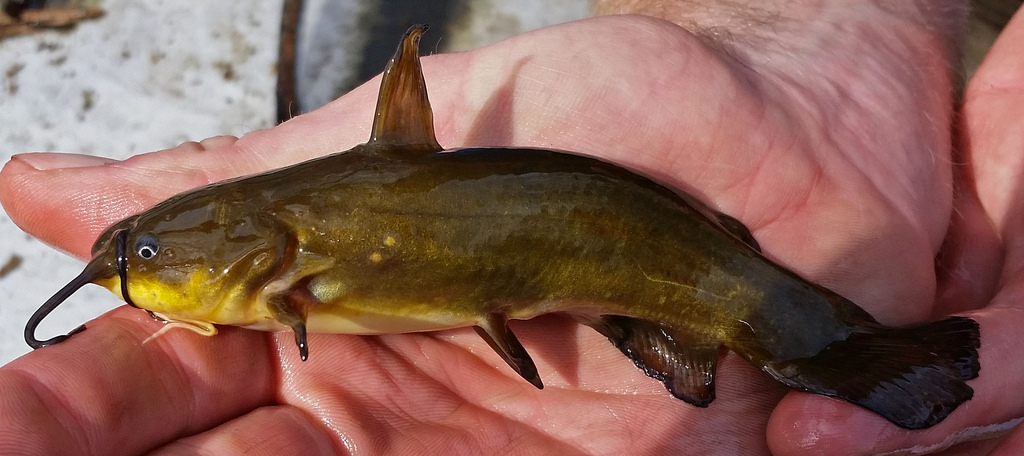
Hardhead Catfish (Ariopsis felis) – Sometimes called steelhead catfish or sea catfish, found along most of the eastern coast and into the Gulf of Mexico. Hardheads are notorious bait stealers, gulping their food rather than biting. Identification: dorsal fin comes to a point and does not extend toward the anal or adipose fin; anal fin with 18–20 rays; colour ranges from greenish to light grey with a whitish belly. Typical size: about 16 inches, up to 12 pounds.
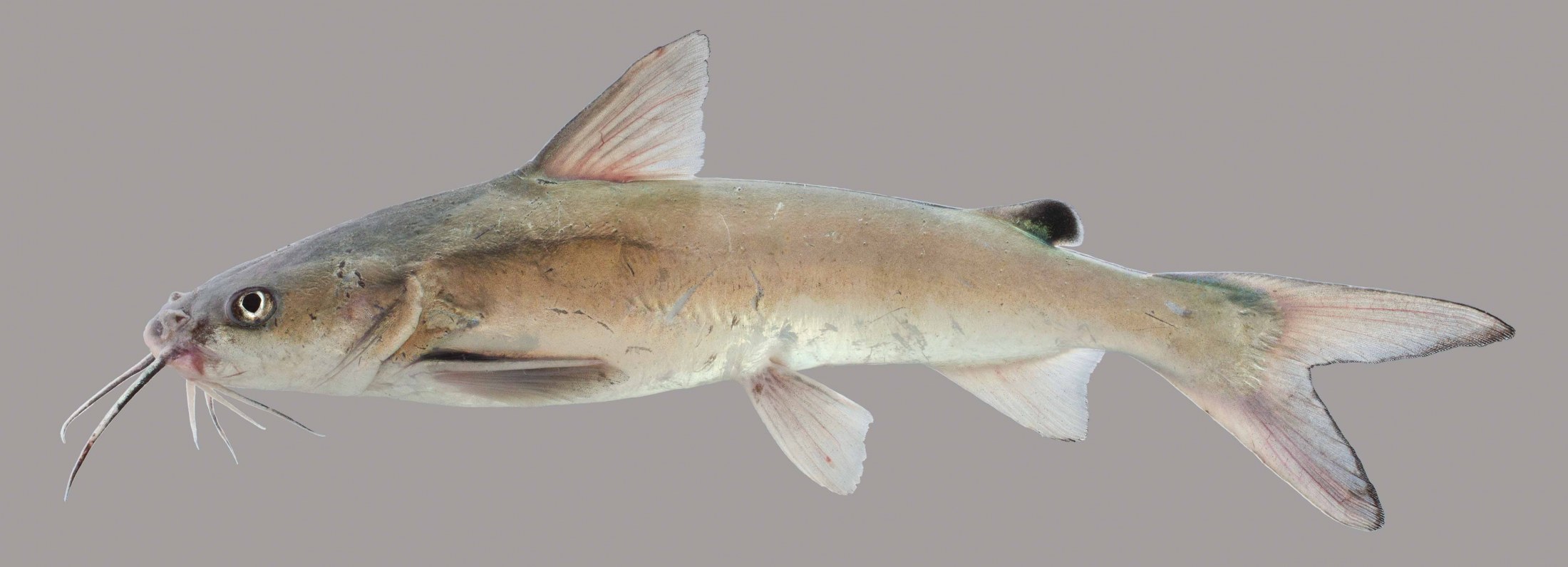
Gafftopsail Catfish (Bagre marinus) – Often called gafftops, found on the east coast of North America, the Gulf of Mexico, and the east coast of South America. Often confused with hardheads. Identification: dorsal fin is ribbon‑like at the tip and extends farther toward the anal and adipose fins; anal fin with 22–28 rays (hardheads have fewer); colour ranges from greenish‑to‑blue with a silverish stomach. Average size: about 18 inches, up to 27 inches and 10 pounds.
Walking Catfish (Clarias batrachus) – Sometimes called Thai catfish, native to Southeast Asia. They get their name from their ability to wiggle and jump their way to new areas, using lung‑like organs that allow them to gulp air. Walking catfish are important in aquaculture and are popular among subsistence anglers. They can survive for several days out of water as long as they stay wet – a trait that makes them valuable in fish markets.

Armored Catfish – Common Plecostomus (Hypostomus plecostomus) – Sometimes called plecos, these are popular among aquarists for controlling algae growth. Identification: dark‑coloured body, armoured plating on the upper body, downturned (sucker) mouth, and light‑coloured belly with black spotting throughout. Unfortunately, plecos are an undesirable invasive species throughout the southern United States, often dumped into local waterbodies when they outgrow their aquaria, negatively affecting native plant and fish populations.
2025–2026 Conservation and Invasive Species Updates
Blue Catfish in the Chesapeake Bay: Blue catfish are considered an invasive species in the Chesapeake Bay. A 4‑ounce serving contains 19 grams of protein with only 90 calories and 1.5 grams of fat – making them both a conservation challenge and a sustainable food opportunity. The USGS Chesapeake Bay Science Accomplishments for 2025 reports that the recent expansion of invasive blue and flathead catfish in the Chesapeake Bay and its major rivers threatens the region's economically important fisheries and treasured natural resources.
In 2025, Maryland established the Invasive Blue Catfish Pilot Program to curb the spread of blue catfish in the Chesapeake Bay and its tributaries, with applications accepted in Spring 2025. Federal legislation was also introduced in July 2025 to facilitate the use of invasive blue catfish in pet food production, targeting one of the greatest predators threatening the ecology and economy of the Chesapeake Bay. Invasive blue catfish have no natural predators in the Chesapeake Bay watershed, can live up to 20 years, and can weigh up to 100 pounds.
Flathead Catfish Impacts: USGS research published in 2025 quantified the effects of invasive flathead catfish on food web structure, showing that flathead catfish invasion is altering food web structure and energy flow in large riverine ecosystems.
2026 Population Surveys: A survey instrument assessing the population structure and efficacy of targeted removal of blue catfish on the Choptank River, Maryland, is expected to launch in 2026. Meanwhile, 2025 surveys in Harrison County Lake, Missouri, showed that flathead catfish are now reproducing naturally with increased numbers of small fish (8–11 inches) observed.
[PROMO INSERT 1 – after discussing the Big Three and identification]
Whether you're targeting trophy blue cats in the Missouri River or bottom‑bouncing for channel cats in your local lake, having the right rod and reel setup makes all the difference. Our 2025–2026 selection of fishing rods and reels includes heavy‑action catfish combos with the backbone to handle 100‑pound giants, and medium‑heavy spinning setups perfect for channel cats. For beginners, our pre‑matched rod & reel combos come spooled with heavy‑duty line and are ready to fish. And a large, rubber‑coated landing net is essential when you're hauling a 60‑inch catfish over the gunwale. Browse the collection at [Shop Rods, Reels & Combos](https://jenseits-fishing.com/collections/frontpage) and build your catfish‑specific arsenal.


Final Thoughts – A Diverse and Fascinating Family
From the 143‑pound blue catfish giants of the Mississippi River system to the 12‑inch yellow bullheads of eastern farm ponds, North American catfish represent one of the most diverse and accessible groups of fish on the continent. Whether you're an angler chasing a state record, a student learning fish identification, or a conservationist monitoring invasive species, understanding the key markers – mouth orientation, barbel colour, anal fin rays, tail shape, body colour, and eye position – will help you confidently identify every catfish you encounter.
2025–2026 Key Takeaways:
-
Channel catfish: 58‑lb world record; 24–30 anal rays; olive to dark grey; forked tail
-
Blue catfish: 143‑lb world record; 30–36 anal rays; bluish to light grey; invasive in Chesapeake Bay
-
Flathead catfish: 123‑lb world record; 14–17 anal rays; lower jaw extends farther; pale yellow to brown
-
White catfish: 22–24 anal rays; blue ring around pupil
-
Black bullhead: 17–21 anal rays; yellowish‑brown to dark green
-
Yellow bullhead: 24–27 anal rays; white barbels (key identifier)
The science of catfish identification continues to evolve. As USGS researchers note, invasive catfish are altering food webs and ecosystem dynamics across the country. Understanding what you're catching – and where it belongs – has never been more important.


